Patient guide · 7 min read
Laser Hair Removal for Darker Skin Tones: What Actually Makes It Safe
Laser hair removal can be safe for darker skin tones, but only with the right wavelength, the right cooling, and a provider who checks your skin before treating it. The risk was rarely the skin itself. It was lasers and settings built for lighter skin.
What the Fitzpatrick scale actually measures
The Fitzpatrick scale is a six-type system, labeled I through VI, that dermatologists use to describe how skin reacts to ultraviolet light. It was designed to predict sunburn and tanning response, and it is still the scale providers use today to plan laser settings.
Type I skin always burns and almost never tans. Type VI skin almost never burns and holds deep, consistent pigment, and most people fall somewhere between the two. Your Fitzpatrick type depends on how your skin responds to the sun, not just how it looks in a photo.
For laser hair removal, this matters because the scale estimates how much melanin sits in the skin itself, not only in the hair. The more melanin in the surrounding skin, the more carefully a provider has to choose wavelength and settings, which is the real story behind outdated advice to avoid laser altogether.
- Type I–II: fair skin that burns easily and rarely tans
- Type III–IV: skin that tans gradually, from light to moderate brown
- Type V–VI: brown to deeply pigmented skin that rarely or never burns
The Fitzpatrick scale
- Type IAlways burns, never tans
- Type IIUsually burns, tans a little
- Type IIISometimes burns, tans evenly
- Type IVRarely burns, tans well
- Type VVery rarely burns, tans deeply
- Type VINever burns, deeply pigmented
Why older lasers burned and discolored darker skin
Laser hair removal works through a process called selective photothermolysis: light energy is absorbed by melanin, heats it, and damages the hair follicle attached to it. That only works while a follicle is in its active growth phase, which is also why a single session never reaches every hair.
The first hair-removal lasers were built around one short wavelength, tuned for the contrast between light skin and dark hair. In Fitzpatrick I–III skin, there is little melanin outside the hair itself, so the laser has an easy target.
In Fitzpatrick IV–VI skin, melanin is spread through the surface of the skin too, not just the hair. A shorter wavelength cannot tell the difference, so it heats the surrounding skin along with the follicle, and that is how blistering, burns, and lasting light or dark patches happened to patients with deeper skin tones on mismatched equipment. That history is real, and it is why many people with brown or Black skin were turned away, or hurt, even though the problem was the device, not their skin.
That history is also why skin of color sometimes still gets labeled a poor candidate for laser treatment in general, instead of what it actually is: a candidate for a different wavelength than the one a clinic happens to have. The distinction matters, because it changes the real question from whether your skin can be treated to whether a given clinic has the right equipment and the judgment to use it well.
Wavelength and cooling: the two settings that make treatment safer
A 755nm Alexandrite laser is absorbed strongly by melanin, which makes it effective on lighter skin, but that same strong absorption is what makes it risky on skin with more background pigment. A 1064nm Nd:YAG laser is absorbed less by surface melanin, so more of its energy reaches past the skin's surface to the follicle below, which is the practical reason it is the wavelength used for Fitzpatrick IV through VI skin.
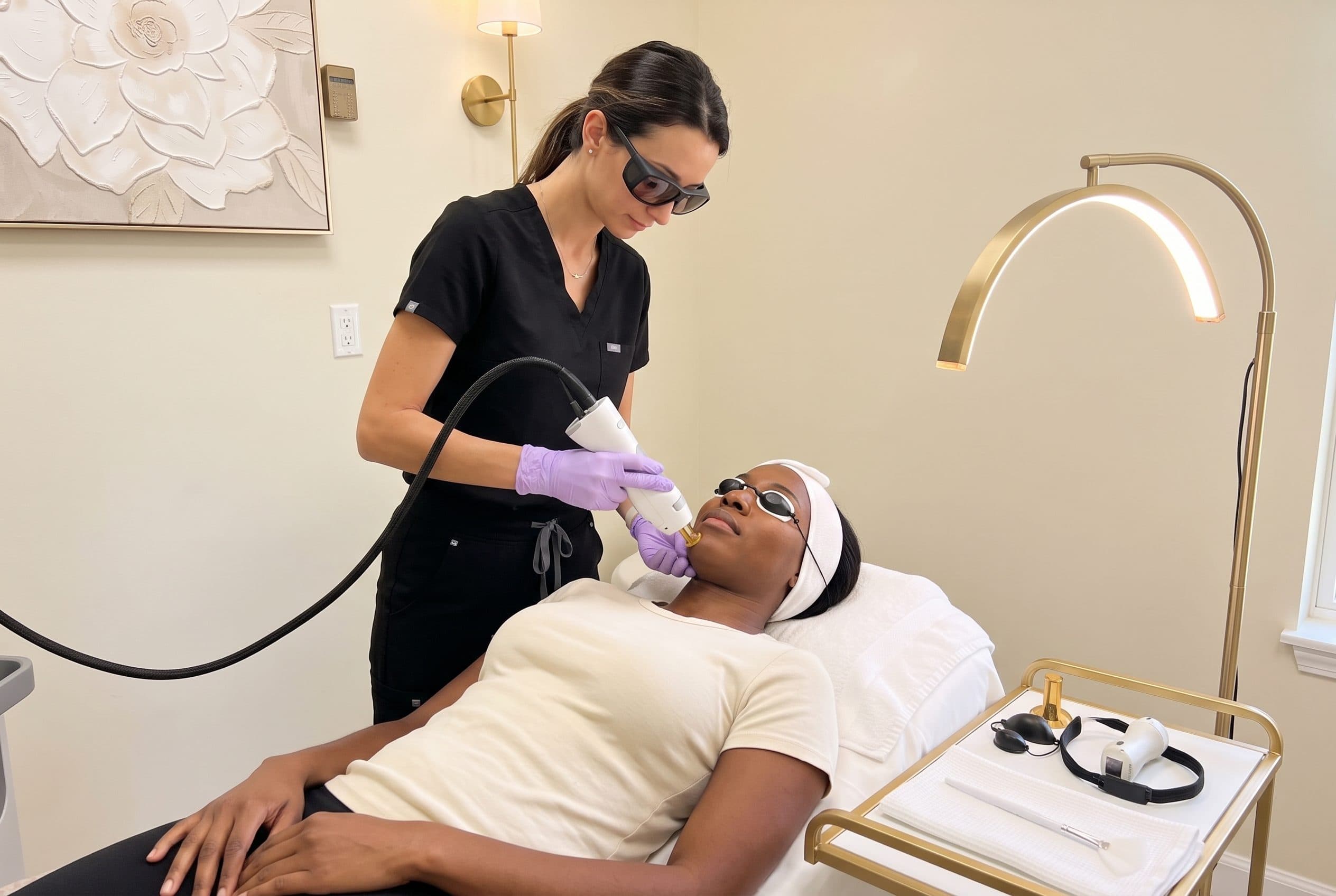
The Candela GentleMax Pro Plus used for laser hair removal in Ellicott City pairs both wavelengths on one machine, so the choice comes from an assessment of your skin and hair, not from whichever single laser a clinic happens to own.
Cooling is the other half of the equation. Each pulse briefly warms the surface of the skin along with the follicle, so a cooling burst applied right before the pulse protects the skin while the laser works. Older devices without built-in cooling relied on numbing cream or nothing at all, which left less margin for error on any skin tone and made sessions less comfortable.
In a clinical study of the 1064nm Nd:YAG wavelength in women with Fitzpatrick IV–V skin, researchers recorded no cases of hyperpigmentation or hypopigmentation after a full course of sessions, though short-term redness and swelling were common and temporary, and a few sessions (under 1 percent) caused blistering. That is a good illustration of what a properly matched wavelength and cooling step can look like in practice, though individual results still vary.
755nm Alexandrite
Lighter skin
- I
- II
- III
1064nm Nd:YAG
Deeper skin tones
- IV
- V
- VI
What a safe consultation, and a test spot, should check
A real consultation is not a formality. It should include a look at your Fitzpatrick type, how your skin actually responds to sun, your hair color and texture, and any history of keloid scarring, cold sores, or skin conditions in the area you want treated.
If you have ever had a burn, blister, or a light or dark patch from a previous laser session anywhere, say so plainly: which device was used, which area, and how your skin healed. A provider who builds your plan around that history, instead of a one-size setting, is the difference between a safe laser hair removal consultation and a repeat injury.
Many providers also treat a small test area first and wait a few days to see how skin reacts before committing to a full course. If a clinic skips straight to a full session on a new patient with no skin assessment at all, that is worth asking about before you book.
This two-step approach, a full assessment followed by a small test area, adds a little time up front, but it catches a problem on a small patch of skin instead of across a whole treatment area. It is a reasonable standard to expect from any clinic, not an extra favor one is doing for you.
- Which wavelengths does the laser offer, and is 1064nm Nd:YAG one of them?
- Has the provider treated patients with my skin tone, and what happened?
- Who performs the skin assessment and chooses the settings?
- What is the plan if I have been burned or discolored by laser before?
How many sessions it actually takes
Hair grows in cycles, and a laser can only disable a follicle while it sits in its active growth phase, called anagen. Because hairs do not all sit in that phase at the same time, no single session reaches every follicle, which is why a course of several sessions is normal for every skin tone, not just darker ones.
Most patients complete 6 to 8 sessions for noticeable, long-term reduction, spaced 4 to 6 weeks apart on the face and 6 to 8 weeks apart on the body, timed to catch new hairs as they cycle back into the growth phase. A single laser hair removal session, even a good one, cannot do that work alone.
Results vary by area, hair color, and hormones, and some patients choose occasional maintenance sessions afterward. Patients across Howard County, from Ellicott City to Columbia, do not need more sessions because of skin tone; they need the right wavelength from session one.
Areas with coarse, dark hair typically show visible change faster than areas with fine or sparse hair. Hormonal shifts, including the ones that happen naturally for some women, can also prompt a few new hairs to grow back on the face even after a full course, which is a normal part of how hair grows rather than a sign the treatment did not work.
How to prepare, and how to care for your skin after
Shave the treatment area about 24 hours before your appointment so the laser can find the follicle below the skin instead of hair sitting above it. Avoid sun exposure and tanning for two weeks before each session, since tanned or sunburned skin carries more surface melanin and more risk, for every skin tone.
Skip waxing, plucking, and threading for about four weeks before and during a course, since those methods remove the follicle the laser needs to target. Shaving between sessions is fine and expected.
Afterward, mild redness or warmth is common and usually settles within a few hours. Wear sunscreen daily on the treated area, avoid direct sun and heat, such as saunas or hot yoga, for 24 to 48 hours, and let treated hairs shed on their own instead of picking or plucking them.
In the days after a session, treated hairs often look like they are still growing before they fall out on their own as the follicle sheds them; that is a normal part of the process, not regrowth. Because the follicle itself is weakened, many people also notice fewer ingrown hairs and less irritation in treated areas over time, compared with shaving or waxing.
Who should wait, or talk to a provider first
Laser hair removal is not right for every moment in someone's life, regardless of skin tone. Tell your provider if you are pregnant or breastfeeding, since treatment is not recommended during that time, if you have an active skin infection in the area, or if you have had intense sun exposure or tanning recently.
Also mention any medication that makes skin more sensitive to light, a history of keloid scarring, or a tendency toward cold sores in the treatment area, since any of those can change the plan a provider recommends. If you are being treated for an active skin condition, like a breakout or eczema flare, in the exact area, mention that too, since inflamed skin can respond differently to a laser pulse.
Because the laser works by targeting pigment, very light blonde, gray, or white hair usually does not respond well on any skin tone. For hair like that, electrolysis, which treats one follicle at a time with an electric current instead of light, remains an option, though it works on a single hair at a time rather than a full area at once.
A clinic that tells you honestly where laser will and will not work, before you commit to a full course, is doing its job. If you are not sure where you fit, take the two-minute quiz to get a sense of what might work before you book a consultation.
Common questions
Is laser hair removal safe for Black or brown skin?
Yes, when the clinic uses a wavelength suited to your skin, like the 1064nm Nd:YAG setting on a dual-wavelength laser, chosen after an actual assessment of your Fitzpatrick type and hair. The outdated advice that laser is not an option for darker skin usually traces back to single-wavelength equipment, not to anything about the skin itself.
Why do some clinics use 1064nm Nd:YAG instead of 755nm Alexandrite?
The 1064nm Nd:YAG wavelength is absorbed less by melanin in the surface of the skin, so more of its energy reaches the follicle instead of heating the skin around it. That makes it the safer choice for Fitzpatrick IV through VI skin, while 755nm Alexandrite remains a strong option for lighter skin with dark hair.
Can I get laser hair removal if I have been burned or had dark spots from it before?
Often, yes, but only after a careful conversation first. Tell a new provider exactly what happened: which device was used, which area, and how your skin healed, so they can choose a wavelength and settings for your skin rather than a generic preset.
Does darker skin need more sessions than lighter skin?
Not because of skin tone itself. Most patients of any skin tone need 6 to 8 sessions spaced 4 to 6 weeks apart on the face and 6 to 8 weeks apart on the body, because hair grows in cycles and a laser can only treat follicles that are in their active growth phase.
What if my hair is blonde, gray, or white?
Laser hair removal targets pigment in the hair itself, so very light blonde, gray, and white hair tends to respond poorly, regardless of skin tone. A provider should tell you this clearly before recommending a full course.
Do I need to avoid the sun before a laser hair removal session?
Yes. Avoid sun exposure and tanning for about two weeks before each session, since tanned or sunburned skin has more surface melanin and carries more risk during treatment, for every skin tone.
Sources
- Laser hair removal overview, American Academy of Dermatology
- Hair removal methods compared, American Academy of Dermatology
- Laser therapy for unwanted hair, American Society for Dermatologic Surgery
- Laser hair removal: mechanism, risks and candidacy, Cleveland Clinic
- Laser Fitzpatrick Skin Type Recommendations, StatPearls (NCBI Bookshelf)
- Evaluation of long-pulsed 1064 nm Nd:YAG laser-assisted hair removal in Indian patients, Journal of Cutaneous and Aesthetic Surgery (PMC)
This guide is general education, not medical advice, and it doesn't replace an assessment by a licensed provider. Results and suitability vary from person to person. First published .